

Table of Contents
- Food as Fortune: The Role of Belief in Irish Cooking
- Love and Marriage: Sweet Signs in Everyday Bakes
- Luck and Prosperity: Foods for Good Fortune
- Protection and Blessing: Food as a Safeguard
- From Superstition to Tradition: Folklore at the Modern Table
Food as Fortune: The Role of Belief in Irish Cooking
In Ireland, food has never been merely sustenance. Across centuries of rural life, hardship, celebration, and faith, meals carried meaning far beyond nourishment. In cottages and farmhouses, certain dishes were believed to influence the future — bringing love, ensuring luck, guarding against misfortune, or protecting a household from unseen forces.
Irish folklore often blurred the line between the practical and the mystical. Cooking was bound to seasonal rhythms, religious observances, and ancient customs that predated Christianity. The act of baking bread, stirring a pot, or sharing a festive dish could carry symbolic weight. To eat was to participate in a tradition shaped by memory and belief.
These ideas were not abstract. They were woven into everyday life. Certain foods were prepared at specific times of year because they were thought to reveal one’s future spouse, predict wealth, or shield a home from harm. Others were offered as blessings, reinforcing bonds between family members and neighbours.
In this way, Irish food became part of a living folklore — an edible language of hope, protection, and possibility.
Love and Marriage: Sweet Signs in Everyday Bakes
Few Irish foods are as closely tied to fortune-telling as barmbrack. Traditionally served around Samhain — the festival that marked the end of harvest and the beginning of winter — this fruit-filled bread concealed small objects baked into its crumb. Each item carried a message for the person who found it.
A ring signified marriage within the coming year. A coin foretold prosperity. A pea or a piece of cloth might suggest bachelorhood or financial difficulty. Children and adults alike cut their slices with anticipation, aware that the bread held playful prophecy.
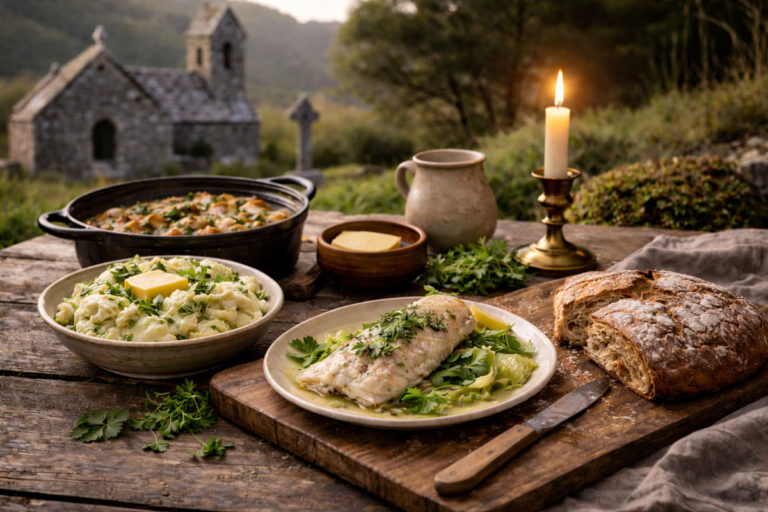
Colcannon, a comforting blend of mashed potatoes and cabbage or kale, also played a role in love-related traditions. On Halloween night, charms were sometimes hidden within the dish. Unmarried girls might place a spoonful beneath their pillow, believing it would bring dreams of a future spouse.
Apple-based traditions also abounded. Apples were linked to fertility and romance in Celtic lore. Peeling an apple in one long strip and tossing the peel over the shoulder was said to reveal the initial of one’s future partner. In these small rituals, everyday food became a vehicle for hopeful imagination.
These customs may seem whimsical now, yet they reveal how deeply food was connected to life’s milestones. Baking and sharing these dishes allowed communities to face uncertainty with humour and anticipation.
Luck and Prosperity: Foods for Good Fortune
Beyond romance, many Irish foods were believed to influence fortune and prosperity. At the New Year, certain dishes symbolised abundance for the months ahead. Bread, in particular, was powerful. A well-risen loaf suggested blessing and stability. Failure in baking could be interpreted as a warning.
Oats and barley were also associated with sustenance and survival. In agrarian Ireland, a strong harvest meant security. Sharing porridge or oatcakes during key seasonal moments reflected gratitude for provision and hope for continued abundance.
Cabbage and root vegetables, especially at harvest festivals, symbolised the fruits of labour. Meals built around freshly gathered produce were celebrations of both land and luck. The very act of preserving food — whether through salting, drying, or storing in root cellars — carried an element of safeguarding future fortune.
Coins baked into bread or cakes served as tangible symbols of prosperity. Finding one in a festive loaf was taken as a sign of financial luck. Even if the belief was light-hearted, the symbolism reinforced communal optimism.
In these traditions, food expressed confidence in the land’s generosity and the household’s resilience.
Protection and Blessing: Food as a Safeguard
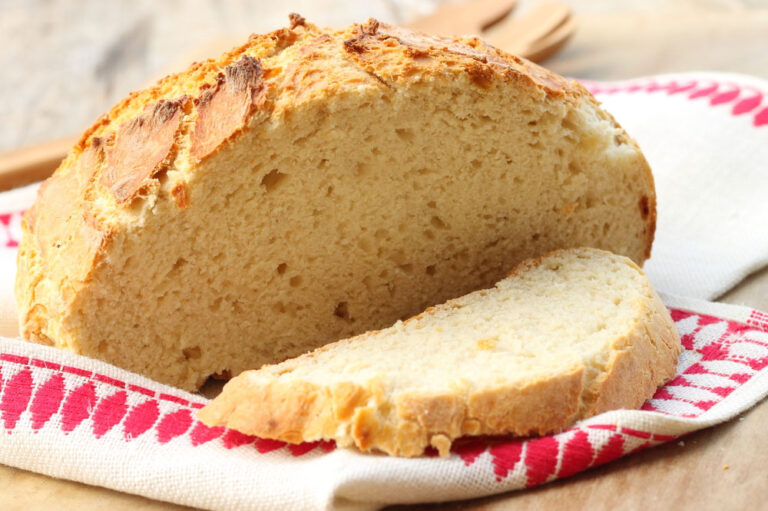
Irish folklore also assigned protective qualities to certain foods. Bread held particular significance. A cross cut into a soda bread loaf before baking was often described as “letting the fairies out” or blessing the bread. Whether interpreted spiritually or symbolically, the act underscored bread’s sacred place in the home.
Salt, frequently paired with bread, was believed to ward off evil. Offering bread and salt to a visitor was both hospitality and protection — a way of ensuring peace within the household.
Milk and butter carried their own associations. In a society where dairy was central to survival, its loss through spoilage or illness was feared. Folklore surrounding butter-making included charms and prayers intended to protect the churn from interference by mischievous spirits.
Even festive feasts could serve protective purposes. Gathering around the table reinforced social bonds, which themselves were considered safeguards against hardship. Food strengthened not just bodies but communities.
These practices reveal a worldview in which nourishment and spiritual wellbeing were intertwined. Eating certain foods at the right time, in the right way, was part of maintaining harmony with both seen and unseen forces.
From Superstition to Tradition: Folklore at the Modern Table
Today, many of these beliefs are observed playfully rather than literally. Barmbrack still appears at Halloween, often with charms included for fun. Soda bread continues to bear its traditional cross, even if few think of fairies when baking it.
Yet the persistence of these customs speaks to something deeper. Food rituals connect generations. They offer continuity in a rapidly changing world. Even when stripped of superstition, the symbolism remains — a reminder of ancestors who cooked with hope and reverence.
Irish food folklore reveals how communities once navigated uncertainty. In a land shaped by weather, hardship, and migration, the promise of love, luck, or protection offered comfort. Dishes became carriers of story, laughter, and belief.
By revisiting these traditions, we glimpse a richer layer of Irish culinary history — one where food was not only eaten, but trusted, cherished, and woven into the fabric of everyday life.
In the end, whether or not a ring in a loaf predicts marriage, the act of sharing such food keeps alive a uniquely Irish blend of imagination, resilience, and warmth.