
Table of Contents
- Introduction: What Is Yellowman?
- A Sweet Tradition: The Origins of Yellowman
- Crafting the Perfect Crunch: How Yellowman Is Made
- Yellowman at the Auld Lammas Fair
- Preserving a Sugary Legacy in Modern Times
Introduction: What Is Yellowman?
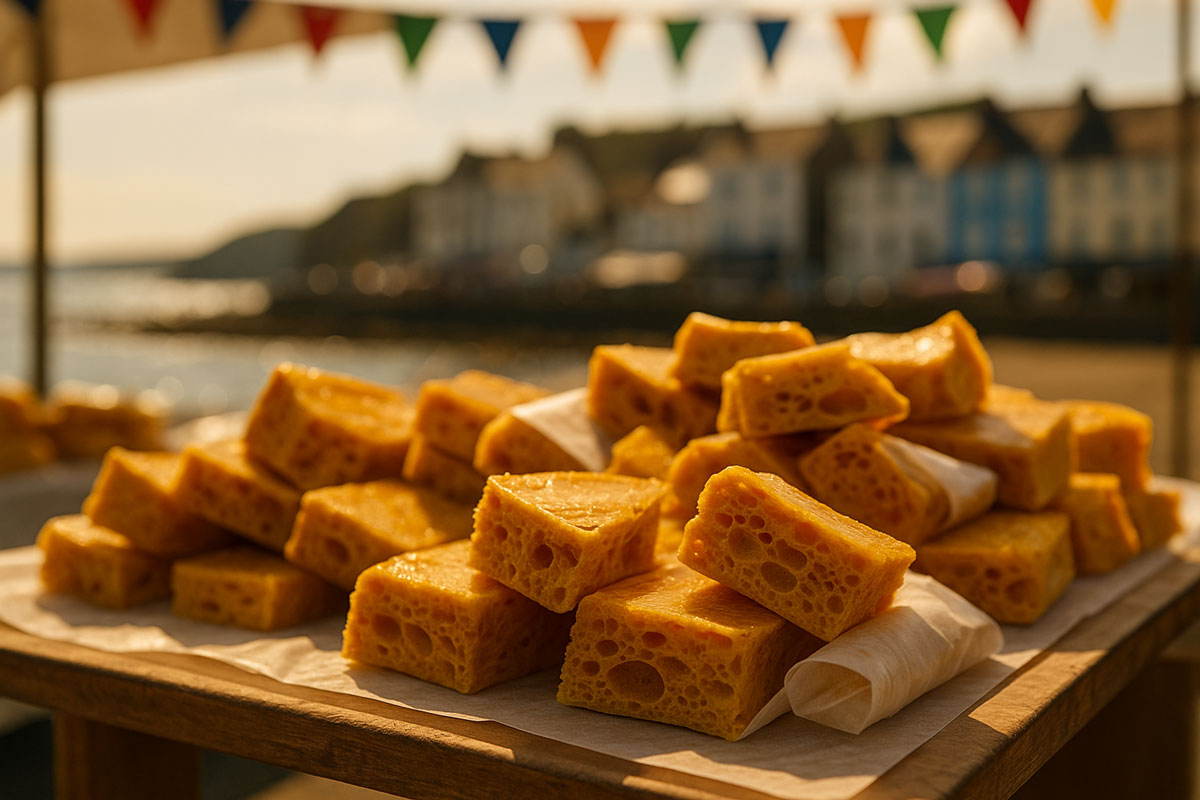
If you’ve ever wandered through the bustling streets of Ballycastle in County Antrim during the late summer, you’ve likely seen stalls stacked high with golden, brittle slabs of a mysterious treat known as Yellowman. This crunchy, honeycomb-like confection has been a beloved feature of Northern Ireland’s fairgrounds and festivals for generations, instantly recognisable by its bright yellow hue and irresistible sugary aroma.
Despite its name, Yellowman doesn’t contain honey—though its airy texture and caramelised sweetness might remind you of it. Instead, it’s a type of traditional boiled sugar sweet, similar in structure to honeycomb toffee or cinder toffee, but with a distinct flavour and appearance that make it uniquely Northern Irish. Made from a simple combination of sugar, golden syrup, vinegar, and bicarbonate of soda, the magic of Yellowman lies in the chemical reaction that causes the mixture to froth and harden into a crisp, bubbly texture.
For many locals, the sight of Yellowman signals more than just a sugar rush—it evokes memories of childhood visits to the Auld Lammas Fair, where generations have snapped off shards of this golden treat from wax paper wrappers. Its nostalgic appeal continues to draw crowds year after year, connecting the present-day sweet tooth to centuries-old traditions.
A Sweet Tradition: The Origins of Yellowman
The exact origins of Yellowman are somewhat shrouded in mystery, much like many cherished regional treats passed down through generations. While similar honeycomb-style confections can be found in various cultures, Yellowman’s distinct name, bright colour, and strong association with Northern Ireland set it apart. It is most famously linked to the Auld Lammas Fair in Ballycastle, a festival that has been running for over 400 years and is one of the oldest traditional fairs in Ireland.
Some food historians suggest that Yellowman may have evolved from older European sugar-boiling traditions, where caramelised sugar was aerated to create a light, brittle texture. As sugar became more accessible in the 19th and early 20th centuries, rural Irish sweet-makers may have adapted these methods, adding their own twist—including the signature golden-yellow colour that would make the confection stand out in crowded markets.
Others believe the treat was initially made by local confectioners to attract children and visitors at seasonal fairs. Its low-cost ingredients, long shelf life, and eye-catching appearance made it ideal for selling in large quantities. Wrapped in greaseproof paper and sold in hefty slabs, Yellowman quickly became synonymous with festive gatherings in County Antrim and beyond.
The name “Yellowman” itself likely emerged as a simple, descriptive term—referring to its striking colour and perhaps to the ‘man’ or vendor selling it at the fair. Over time, the treat gained an almost legendary status, with some families passing down their own guarded recipes, tweaking the balance of syrup, sugar, and aeration for the perfect crunch.
By the mid-20th century, Yellowman had cemented its role as a cultural icon of Northern Irish fairs. Its history is not only about sugar and syrup—it’s about community, shared memories, and the enduring appeal of a humble yet delightful sweet that continues to bring people together.
Crafting the Perfect Crunch: How Yellowman Is Made
While Yellowman’s ingredients are simple, the magic lies in the method. At its heart, Yellowman is made from sugar, golden syrup, vinegar, and bicarbonate of soda. Yet, achieving the perfect texture—light, airy, and crisp without being too hard—requires skill, timing, and an understanding of the old-fashioned art of sugar boiling.
The process begins by gently heating sugar and golden syrup in a large pan until they dissolve together into a thick, bubbling liquid. The vinegar is added next—not for flavour, but to help prevent the sugar from crystallising, ensuring a smooth, even texture. Once the mixture reaches the right temperature, the heat is removed, and the most important ingredient—bicarbonate of soda—is whisked in.
This is the moment of transformation. The bicarbonate reacts with the hot syrup, releasing carbon dioxide and causing the mixture to foam dramatically. It’s this reaction that creates the network of tiny air bubbles, giving Yellowman its signature honeycomb texture. The frothy mixture is quickly poured onto a prepared surface or tray, where it’s left to cool and harden.
Once set, the slab of Yellowman is broken into pieces—often with a satisfying crack. Traditionally, it’s wrapped in greaseproof or waxed paper to keep it fresh and to prevent the sticky edges from clumping together. Unlike chocolate-coated honeycomb found elsewhere, Yellowman is served plain, allowing its golden colour and pure caramelised flavour to shine.
Homemade versions are still made in some Northern Irish kitchens, particularly around fair time, but most people enjoy it from market stalls, sweet shops, or specialty confectioners who have perfected their recipes over decades. The challenge lies in balancing the ingredients so the Yellowman is crunchy yet light, without being overly sticky or brittle.
For those willing to try making it at home, caution is key—boiled sugar can cause serious burns, and precise timing is crucial to avoid undercooking or burning. But for those who master it, the reward is a truly authentic taste of Northern Ireland’s culinary heritage.
Yellowman at the Auld Lammas Fair
No discussion of Yellowman is complete without mentioning the Auld Lammas Fair in Ballycastle, County Antrim. Held annually on the last Monday and Tuesday of August, this centuries-old event is one of Ireland’s oldest traditional fairs, with roots stretching back over 400 years. Originally a harvest market where livestock, farm goods, and crafts were traded, it has evolved into a vibrant celebration of music, culture, and food—of which Yellowman is undoubtedly the star attraction.
Stalls selling towering stacks of Yellowman line the streets during the fair. Vendors wrap the slabs in waxed paper, often weighing them out in generous portions. The sight of children clutching their golden sweets as they weave through the bustling crowd is as much a part of the fair’s atmosphere as the sound of traditional music or the smell of fresh bread and grilled meats.
Yellowman’s presence at the Auld Lammas Fair is so iconic that for many visitors, it is inseparable from the experience itself. Locals and tourists alike often buy extra slabs to take home, either as a nostalgic treat or as a gift for friends and family. Some even save a piece as a keepsake, wrapped and tucked away, as a reminder of the summer festivities.
Over the years, the fair has welcomed visitors from around the world, many of whom are drawn to Ballycastle not only for the heritage and entertainment but also to sample authentic Yellowman at its source. It has become a culinary symbol of Northern Ireland’s north coast, representing both tradition and the joy of shared community celebrations.
Today, the Auld Lammas Fair continues to thrive, with Yellowman at its sugary heart. While the event has expanded to include modern attractions and international visitors, the tradition of snapping off a piece of this golden confection remains unchanged—a sweet link between past and present.
Preserving a Sugary Legacy in Modern Times
In an age where global food trends and modern confections dominate the shelves, Yellowman remains a proud symbol of Northern Irish tradition. While it may not be as widely available as mass-produced sweets, its rarity is part of its charm—making it a treat to be sought out and cherished rather than something taken for granted.
Specialist sweet shops and artisan confectioners across Northern Ireland still craft Yellowman using time-honoured methods, often in small batches to ensure quality. Some continue to use family recipes that have been passed down for generations, while others have introduced small variations—such as different flavour infusions or slight texture adjustments—to appeal to modern palates. However, the essence of Yellowman has remained unchanged: golden, airy, and deeply nostalgic.
Festivals, food markets, and local fairs outside Ballycastle have also begun to embrace Yellowman, introducing it to new audiences. Social media has played a role in its revival too—visitors snapping photos of the bright slabs against the backdrop of the Auld Lammas Fair have helped spread awareness far beyond Northern Ireland.
There’s also a growing appreciation for Yellowman among those seeking to reconnect with regional heritage foods. Food historians and cultural organisations recognise it as an important part of the country’s culinary history, and it has even appeared in tourism campaigns celebrating Northern Ireland’s unique food culture. For many, buying a piece of Yellowman isn’t just about indulging a sweet tooth—it’s about taking home a piece of local identity.
As long as the Auld Lammas Fair continues to draw crowds and local confectioners keep their sugar pans bubbling, Yellowman will remain more than just a treat—it will endure as a crunchy, golden link to Northern Ireland’s past. And for those lucky enough to taste it, the first bite will always carry the unmistakable flavour of tradition, celebration, and community spirit.