


St. Patrick’s Day and the Lenten Table: When Feast Met Fasting
St. Patrick’s Day arrives dressed in green and celebration, but for much of Irish history it often landed right in the middle of Lent—a season defined by restraint, simplicity, and spiritual focus. That overlap created a fascinating tension in Irish food culture: a day of honour and festivity set against weeks of self-denial. In many households, St. Patrick’s Day wasn’t a blowout feast in the modern sense. It was a modest brightening of the table, a pause in the ordinary rhythm of fasting, and a reminder that joy and discipline can share the same kitchen.
To understand what the Irish “really ate” for St. Patrick’s Day, it helps to set aside the loudest modern images and step into older Ireland: a country of small farms, seasonal scarcity, strong religious practice, and meals built around what was actually available in March. Here, the story isn’t just about one dish—it’s about how communities negotiated hunger, holiness, and hospitality when feast met fasting.
Table of Contents
- The Old Irish Calendar: Lent Was the Background Music
- Did Ireland “Get a Pass” on St. Patrick’s Day?
- The March Pantry: What Was Actually Available?
- What the Irish Ate When Feast Met Fasting
- Corned Beef: Why It’s Famous (But Not Traditionally Irish)
- After Mass, Before the Music: The Social Side of the Table
- How to Recreate the “Lenten Feast” at Home
- Closing: The Real Tradition Is Balance
The Old Irish Calendar: Lent Was the Background Music
For generations, Lent shaped everyday life in Ireland. It wasn’t simply a personal devotion; it was a community pattern. People expected less meat, plainer meals, fewer treats, and a more careful approach to the pleasures of the table. In practice, the strictness could vary by family, region, and era, but the general idea held: Lent was a time to “make do,” to simplify, and to keep one’s appetite in check.
And then came March 17th—St. Patrick’s Day—carrying both national pride and religious meaning. In many places, it offered a brief breath of celebration. Not always a full exemption from Lenten discipline, but often a softening: a better supper, a special loaf, a shared meal after Mass, or a treat saved up from careful weeks.
Did Ireland “Get a Pass” on St. Patrick’s Day?
It’s common to hear that St. Patrick’s Day was “an exception” to Lenten fasting, and sometimes it was—but not always, and not everywhere. Ireland’s relationship with fasting was historically strong, and people often approached the day with a mixture of reverence and practicality. Some families treated it as a genuine feast day: meat on the table, neighbours invited, a bit of music, and a sense of release. Others kept it more restrained: still Lenten, but brighter—perhaps fish instead of meat, or a larger meal made from simple staples.
What mattered most wasn’t extravagance. It was meaning. Even a “feast” could be humble: a pot filled to the brim, a rare taste of butter, a better cut of bacon if it could be spared, or fresh bread served warm rather than stretched over days.
The March Pantry: What Was Actually Available?
March in Ireland is a shoulder season. Winter stores are dwindling, and spring abundance hasn’t fully arrived. Historically, that meant a table built around what endured: potatoes, cabbage, oats, flour, salted or cured meat when available, milk and butter in dairying areas, and fish where coastal access made it practical.
This is one reason so many “traditional” Irish meals feel plain by modern standards—they were designed to be nourishing, reliable, and based on what you could store. On St. Patrick’s Day during Lent, families didn’t suddenly transform into lavish cooks. They simply leaned into their best versions of ordinary foods.


What the Irish Ate When Feast Met Fasting
1) Fish on the Feast Day
In many Lenten households, fish was the obvious choice for St. Patrick’s Day—especially if the day was treated as celebratory but still within fasting boundaries. Salted or fresh fish (depending on region), smoked fish where it was available, or simple fish stews could turn a plain day into a notable one. A fish supper could feel “special” without breaking the season’s discipline.
2) Potatoes: The Constant Companion
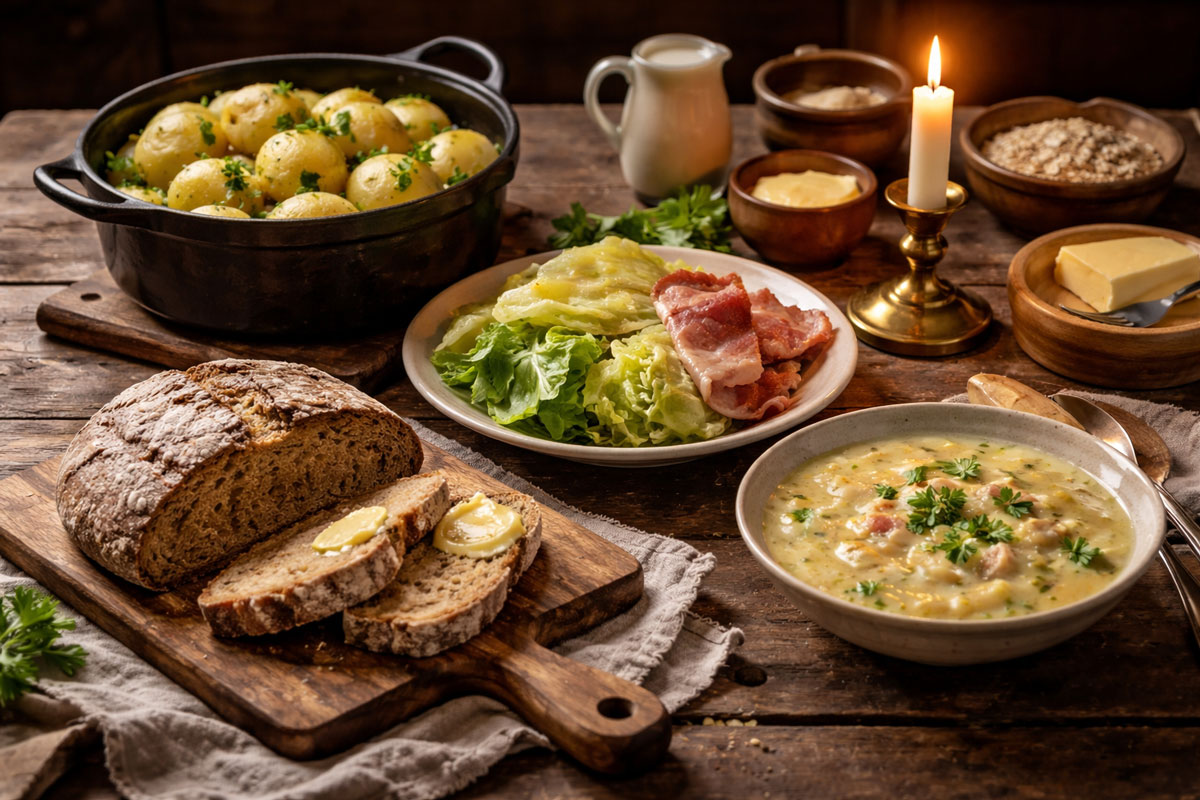
If there was one food that bridged fasting and feasting in Ireland, it was the potato. On ordinary days it might be plain, boiled, and served with a pinch of salt. On St. Patrick’s Day, the difference could be what went with it: a little more butter, a richer mash, cabbage cooked more tenderly, or a pot that included bacon or a bone for flavour.
3) Cabbage and Greens
Cabbage was reliable, filling, and still accessible in March. During Lent, it paired naturally with potatoes and a bit of dairy. When the day allowed, cabbage might be cooked with bacon or served alongside a meat portion. If not, it could still be “dressed up” with butter, milk, or a sprinkle of seasoning. In a household used to restraint, that alone could feel festive.
4) Oat-based Meals and Simple Baking
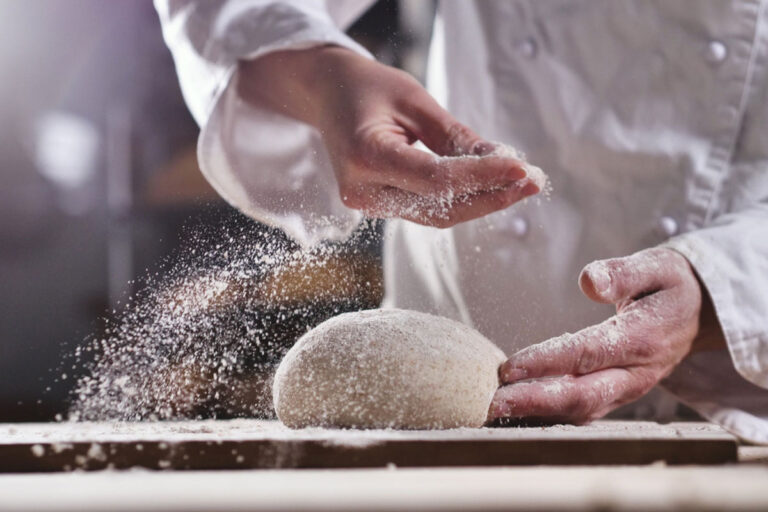
Oats—porridge, oatcakes, and griddled breads—were foundational foods that fit Lenten simplicity perfectly. But even these could shift into “feast mode” with small changes: a touch of sweetness, a richer fat, or serving fresh bread while it was still warm. A special loaf didn’t have to be sugary to feel like a celebration—it just had to be fresh.
5) Bacon as the Bridge Between Seasons
When people imagine an Irish celebratory meal, they often picture bacon and cabbage. Historically, bacon was one of the more realistic meats for rural households—preserved, portioned, and stretched across time. If St. Patrick’s Day was treated as an exemption or semi-exemption, bacon could appear as a symbolic “best meal” without being wildly extravagant. Even a small portion could elevate the entire table.
Corned Beef: Why It’s Famous (But Not Traditionally Irish)
No St. Patrick’s Day food discussion can ignore corned beef. It’s iconic in Irish-American tradition, but it wasn’t the common celebratory meat in Ireland for most families. In older Irish contexts, beef tended to be less accessible for everyday households, while bacon (cured pork) was more practical. Irish immigrants, adapting to new markets and new affordability, embraced corned beef in America—creating a tradition that’s meaningful and real, just not historically rooted in Ireland’s typical March table.
So if you’re celebrating today, you can hold both truths at once: corned beef is part of the St. Patrick’s Day story—especially abroad—while bacon and cabbage, fish suppers, and simple breads better echo what many families in Ireland actually had.
After Mass, Before the Music: The Social Side of the Table
St. Patrick’s Day was—and remains—tied to church life. For many, the heart of the day began with Mass, followed by visiting, shared meals, and community gathering. In older Ireland, hospitality mattered. Even when times were hard, people found ways to offer something: tea, fresh bread, a plate set down for a visitor, or a pot kept warm for family arriving after church.
In a season like Lent, that hospitality often became more intentional: less waste, more care, and a sense that any “extra” carried weight. A neighbour invited in was not casual—it was an act of honouring the day.
How to Recreate the “Lenten Feast” at Home
- Keep it simple: potatoes, cabbage/greens, and one “special” element (butter, fish, or a small portion of bacon).
- Make fresh bread: soda bread or oatcakes turn an ordinary meal into a feast without extravagance.
- Choose a Lenten-friendly centre: a fish bake, smoked haddock, or a hearty vegetable soup with brown bread.
- Honour the day with the table: light a candle, set the table properly, and eat slowly. That’s traditional in spirit.
- If you serve corned beef: name it honestly as an Irish-American tradition—then pair it with Irish staples like colcannon or brown bread.
Closing: The Real Tradition Is Balance
St. Patrick’s Day didn’t always look like parades and overflowing plates. In many Irish homes, it was a day of prayer, community, and a meal that felt special precisely because it emerged from restraint. When feast met fasting, Irish cooks did what they always did: they made meaning out of what they had. And in that humble, steady way, they taught something worth carrying into modern celebrations—joy doesn’t require excess. Sometimes it only requires a shared table, a warm pot, and a grateful heart.