

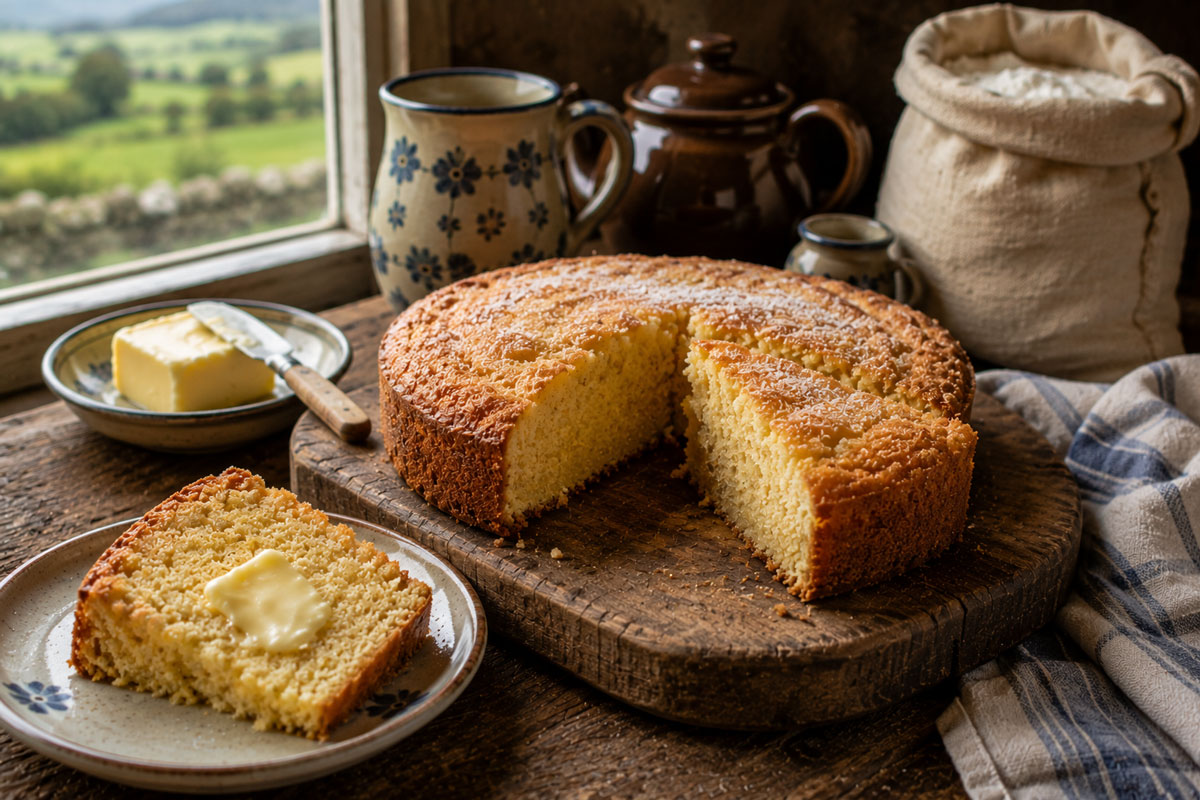
Some of Ireland’s most memorable foods were never elaborate. They were made from whatever a household had close at hand: flour from the pantry, eggs from the hens, milk or buttermilk from the farm, and, when available, generous amounts of freshly churned butter. From these simple ingredients came the rich farmhouse cakes that became part of everyday baking in rural Ireland.
Irish farmhouse butter cake was less a single strictly defined recipe than a style of home baking shaped by Ireland’s remarkable dairy tradition. Recipes differed from kitchen to kitchen, but the idea was wonderfully simple—a tender, buttery cake made from familiar ingredients and served without unnecessary decoration.
These were cakes for family gatherings, Sunday afternoons, visitors arriving at the door, and cups of strong tea around the kitchen table. Their story offers a glimpse into a time when Irish baking was closely connected to the farm, the seasons, and the ingredients produced within a few miles of home.
The Tradition of Irish Farmhouse Baking
For generations, baking was an essential part of life in Irish farmhouses. Bread, scones, cakes, and other baked goods were usually made at home rather than purchased from a shop. Recipes were practical, economical, and based on ingredients that were readily available.
Many recipes were never written down. They were learned by watching a mother, grandmother, aunt, or neighbor at work in the kitchen. Measurements might be made with a familiar cup or spoon, while experienced bakers judged dough and batter largely by appearance and feel.
The result was a style of baking that varied considerably from household to household. Two neighboring families might make very different versions of what they both called butter cake.
What these cakes generally shared was simplicity. They did not require elaborate decorations or expensive ingredients. Their appeal came from good butter, fresh eggs, careful baking, and the comfort of something homemade.
Why Irish Butter Was So Important
Ireland’s climate has long favored dairy farming. Frequent rainfall and mild temperatures help produce the lush grasslands that have supported cattle for centuries, making milk, cream, buttermilk, and butter central ingredients in Irish food culture.
On traditional farms, butter making was once a regular household activity. Cream was collected and churned until the butterfat separated from the liquid buttermilk. The butter could then be washed, worked, shaped, and sometimes salted to help preserve it.
Fresh farmhouse butter had many uses, but baking was certainly among the most delicious. Butter added richness and tenderness to cakes while giving them a distinctive flavor that required little additional embellishment.
In a simple cake containing only a handful of ingredients, the quality of the butter mattered enormously. It was not merely another ingredient—it was often the flavor around which the entire cake was built.
What Was an Irish Farmhouse Butter Cake?
There is no single historic recipe that defines an Irish farmhouse butter cake. Rather, the name can describe a broad family of simple butter-rich cakes prepared in home kitchens using everyday ingredients.
A typical version might contain butter, flour, sugar, eggs, and milk or buttermilk. Depending on the household and period, baking soda or baking powder could provide additional lift.
The finished cake was generally straightforward and rustic. Instead of thick icing or elaborate decoration, it might be served plain, lightly dusted with sugar, or accompanied by homemade jam.
Some versions were relatively dense and rich, while others had a lighter crumb. The amount of sugar could also vary, particularly when sugar was more expensive and used carefully in rural households.
The beauty of the farmhouse butter cake was precisely this lack of strict rules. It was a cake shaped by the ingredients, equipment, and preferences of the person baking it.
Baking in the Country Kitchen
Making a cake in an old Irish farmhouse could be very different from baking one today. Modern cooks can set an oven to an exact temperature and use electric mixers to prepare a batter within minutes. Earlier generations relied far more heavily on experience.
Depending on the period and household, cakes could be baked near the hearth, in cast-iron pots, in ranges, or eventually in increasingly common domestic ovens. Bakers learned to judge heat without digital displays or precise thermostats.
Butter and sugar were creamed by hand, eggs beaten manually, and flour carefully incorporated using wooden spoons and bowls that might remain in a family kitchen for decades.
Nothing about the process was especially glamorous, yet the smell of butter cake baking would have transformed the kitchen. In homes where ingredients were used carefully, a cake coming from the oven signaled that something a little special was happening.
Butter Cake and the Irish Tea Table
Perhaps the natural home of farmhouse butter cake was beside the teapot.
Tea became deeply embedded in Irish domestic life, and offering something to eat alongside it became an important part of hospitality. Visitors rarely needed a formal invitation. Someone arriving at the door might soon find themselves seated at the kitchen table with a cup of tea and whatever bread, scones, biscuits, or cake happened to be available.
A simple butter cake was particularly well suited to these occasions. It could be prepared ahead of time, sliced easily, and served without ceremony.
Homemade jam might accompany a slice, especially during summer and autumn when berries and orchard fruits were preserved for use throughout the year. At other times, the cake needed nothing more than a hot cup of tea.
This tradition of sharing simple baked foods helped make the Irish kitchen table an important place of conversation, news, friendship, and hospitality.
Different Cakes from Different Kitchens
One of the pleasures of traditional farmhouse cooking was variation. Recipes naturally changed according to what was available.
A handful of raisins or currants might turn an ordinary butter cake into something more festive. Lemon zest could provide brightness when citrus fruit was available, while apples from a nearby orchard could be incorporated during the autumn.
Some bakers used buttermilk, taking advantage of the liquid remaining after butter was churned. Others relied on fresh whole milk. The richness of the eggs, type of flour, amount of butter, and even the oven itself could change the finished cake.
Families also developed their own preferences. One household might favor a moist, dense cake, while another baked something lighter. These differences were part of the tradition rather than imperfections that needed to be standardized.
Why Traditional Farmhouse Baking Changed
During the twentieth century, the way Irish families obtained and prepared food changed dramatically. Commercial bakeries expanded, packaged cakes became widely available, and supermarkets offered conveniences previous generations could hardly have imagined.
At the same time, fewer households churned their own butter or produced all of their food at home. Modern ovens, electric mixers, and standardized recipes transformed baking itself.
These changes made life considerably easier, but some of the informal traditions of farmhouse baking gradually faded. Recipes that had been passed verbally through generations could disappear when younger family members no longer learned them.
Simple butter cakes also faced competition from an ever-growing variety of pastries, desserts, and commercially produced treats.
The Return of Simple Irish Baking
In recent years, interest in traditional Irish baking has found a new audience. Home cooks are once again exploring soda breads, oatcakes, fruit loaves, scones, and simple cakes made with high-quality local ingredients.
Ireland’s butter has also gained an international reputation, drawing renewed attention to the country’s exceptional dairy heritage. For bakers, this makes the traditional idea of a butter-centered cake particularly appealing.
Modern versions may be baked in precise ovens and prepared with electric mixers, but their appeal remains much the same: good butter, simple ingredients, and a cake meant to be shared.
Farm shops, cafés, country markets, and artisan bakeries have also helped revive interest in straightforward baked goods that feel connected to Irish home cooking rather than elaborate restaurant desserts.
A Taste of the Irish Farmhouse
The story of Irish farmhouse butter cakes is not really the story of one famous recipe. It is the story of countless kitchens and countless bakers who transformed ordinary farm ingredients into something special.
Butter from grazing cattle, eggs collected close to the house, milk from the farm, and flour from the pantry could become a cake shared among family members or offered to an unexpected visitor.
That simplicity is precisely what gives farmhouse baking its enduring appeal. The cake did not need to be perfectly shaped, elaborately decorated, or reserved for an important celebration. It belonged naturally on the kitchen table.
A warm slice of butter cake beside a cup of tea offers a small taste of that older Irish tradition—a reminder that some of the country’s most comforting foods were created not through complexity, but through good ingredients, practiced hands, and the simple pleasure of sharing what was available.