
Table of Contents
- The Hearth as the Heart of the Irish Home
- Fuel, Firekeeping, and Daily Ritual
- How the Open Fire Shaped Irish Cooking
- Tools of the Hearth: Pots, Griddles, and Crane Arms
- Decline, Memory, and a Modern Revival
The Hearth as the Heart of the Irish Home
In traditional Irish life, the open fire was more than a place to cook. It was the centre of the home’s warmth, work, and social life—an anchor around which daily routines unfolded. In cottages across the countryside, the hearth served as kitchen, heater, gathering place, and symbol of security all at once. Long before central heating or electric ovens, the open fire provided the steady comfort that made a damp Irish winter bearable.
To understand older Irish cooking, you have to picture the home as it once was: a single main room where most activities took place. The fire burned in that room, and everything else gathered around it—meals, storytelling, mending, visits, and quiet evenings after a day in the fields. Food came from the land, but it was shaped, transformed, and made nourishing at the hearth.
The hearth also represented hospitality. A visitor was often offered a seat near the fire first, and food—if it could be spared—followed soon after. The warmth of the open fire was literal, but it was also social and symbolic. A well-kept fire suggested a well-run household, a place where family and neighbour were welcome and where winter hardship was met with steadiness rather than panic.
In folklore and memory, the hearth holds a special place. It appears in stories as the site of blessings and protection, of conversations held close and private, and of the everyday resilience that sustained communities. In many older homes, the fire never truly went out unless there was sickness or scarcity. Keeping it alive was part of keeping the home alive.
Even the layout of many Irish houses reflects this reality. The hearth dictated where people sat, how food was prepared, and where the most important work was done. It shaped domestic life in ways that modern kitchens—separated rooms with specialised appliances—rarely do.
Fuel, Firekeeping, and Daily Ritual
An open fire demanded attention. It did not run in the background like a modern radiator or cooker. It had to be lit, fed, managed, and protected from wind and damp. Firekeeping was a daily responsibility, and it required knowledge—how to coax flame from embers, how to layer fuel, and how to maintain steady heat for cooking without wasting precious resources.
In much of Ireland, turf was the defining fuel. Cut from the bog, dried, and stacked, turf provided a slow, fragrant burn that warmed a cottage and gave food a distinctive comfort. The work behind turf was immense: harvesting it in season, bringing it home, and storing it to keep it dry. In coastal areas and places with fewer bogs, people relied more on wood, furze, or whatever fuel could be gathered and spared.
Firekeeping shaped the rhythm of the day. Mornings began with tending the hearth—reviving embers if they were banked overnight, or lighting a new fire when needed. In many households, ashes were drawn forward, kindling laid carefully, and flame coaxed into life before anything else could happen. Tea, porridge, or a pot of something warming depended on it.
There were also practical rituals: banking the fire at night to preserve heat, drying damp clothes by the hearth, and warming water for washing. The open fire was a domestic engine. It powered cooking, yes, but it also supported almost every other task that required heat.
The importance of the fire influenced household behaviour in subtle ways. People learned to cook efficiently, using the heat that was already there. Pots simmered for long periods because fuel burned slowly. Leftovers were reheated at the edge of the hearth rather than in a separate appliance. Bread might be baked when the fire was strongest, then soups or stews left to keep at a gentle bubble as the heat declined.
To modern eyes, this might look like constant labour. Yet many people who grew up with open fires describe it as a rhythm—steady, purposeful, and familiar. The fire gave structure to the day, and in turn the day was organised around making the most of the fire.
How the Open Fire Shaped Irish Cooking
Irish cooking was shaped not only by ingredients, but by heat. An open fire does not offer the controlled, even temperatures of an oven. It offers zones—hot, warm, and barely simmering—depending on how close you are to the flame or the embers. This reality influenced what Irish people cooked and how they cooked it.
Boiling and simmering became dominant techniques because they were reliable. A pot hung over the fire could maintain steady heat for hours, producing broths, soups, and stews that softened tougher cuts of meat and turned humble vegetables into something sustaining. These dishes also stretched ingredients. A small bit of bacon, a bone, or a handful of barley could flavour a whole pot, feeding many mouths from limited resources.
One-pot cooking fit the Irish household perfectly. It reduced waste, used fuel efficiently, and allowed meals to be built gradually. A pot might begin with bones and water, then vegetables added, then oats or barley stirred in as it thickened. This slow layering created meals that felt rich despite humble ingredients.
The open fire also encouraged griddle cooking. Soda bread, oatcakes, and potato cakes could be cooked on a hot griddle over the fire rather than baked in an oven that many homes did not have. This is one reason griddle breads became so central in Irish food culture. They were practical, quick, and suited to the tools available.
Roasting was possible but less everyday. When it happened, it was often reserved for special occasions or larger households with better fuel supplies. Meat might be roasted on a spit or cooked near the flame, requiring attention and turning. For most families, boiling remained more practical, ensuring food was cooked through without burning and without using excessive fuel.
Even the taste of Irish food was shaped by the hearth. Smoke and turf scent clung to the air and sometimes to the food itself. Kettles, pots, and griddles absorbed the character of the fire over time. The hearth gave Irish cooking a flavour that was as much atmosphere as ingredient—warmth you could almost taste.
Tools of the Hearth: Pots, Griddles, and Crane Arms
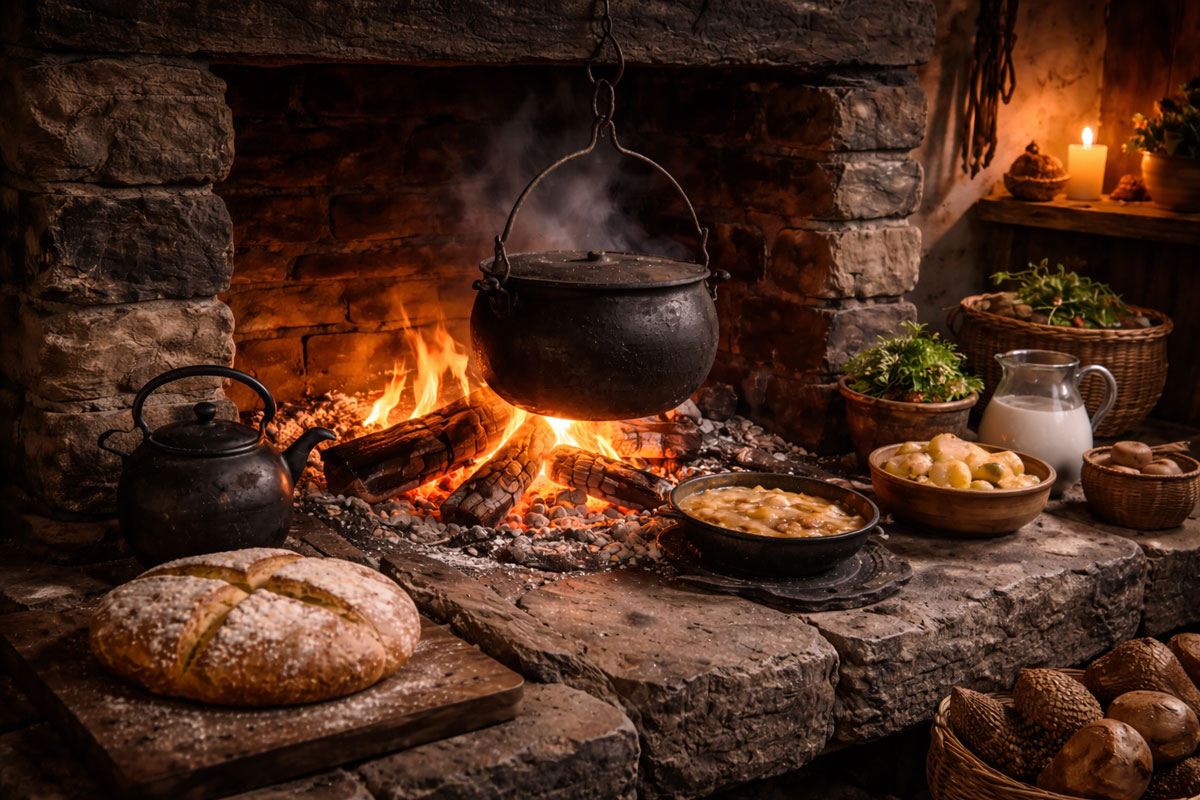
The open fire required specialised tools, and these tools influenced the kinds of meals that could be made. In many Irish homes, the pot was king: a heavy iron pot that could hang over the flames, sit on embers, or be shifted to adjust heat. This pot made everything possible—soups, stews, porridge, boiled potatoes, and long-simmered broths.
Hanging pots were often suspended from a crane arm or chain. The crane allowed the cook to move the pot closer to or farther from the heat, controlling the simmer without a dial or thermostat. It was simple technology, but it offered a remarkable level of control once you learned to read the fire.
Griddles were equally important. A flat iron pan set over the flames could cook breads and cakes quickly. Soda bread, farls, boxty, and oatcakes all fit naturally into this system. In many households, this was the primary “baking” method, especially before enclosed ovens became common.
Other tools completed the hearth system: a kettle always close at hand, tongs and pokers for tending turf, trivets or iron stands for setting pots at different heights, and baking bastibles or pot-ovens in some regions. A bastible, essentially a lidded pot placed among embers with coals on top, allowed bread to bake with heat from above and below—an ingenious workaround in homes without a proper oven.
These tools were durable and often inherited. They carried the marks of years of cooking: soot-darkened surfaces, worn handles, and the quiet familiarity of objects used daily. In a traditional Irish kitchen, cookware was not decorative. It was essential equipment, tied to survival and skill.
Cooking over an open fire also demanded instinct. Timing was learned through repetition. Heat was judged by feel and observation: the colour of embers, the sound of simmering, the speed at which butter melted. This sensory knowledge—passed down within families—was as important as any written recipe.
Decline, Memory, and a Modern Revival
The open fire began to decline as Ireland modernised. Enclosed ranges, then electric cookers, and later central heating changed the structure of domestic life. Cooking moved from the centre of the main room into a dedicated kitchen space. Heat became controlled, convenient, and separate from the social heart of the home.
This shift brought undeniable benefits. Homes became warmer, cleaner, and less smoky. Cooking became easier and more predictable. Yet something was lost as well: the hearth’s role as a shared focal point, and the everyday intimacy of life organised around fire.
For many Irish people, the memory of the open fire remains vivid. It is associated with comfort, storytelling, and the smell of turf on a wet evening. Food memories often return to the hearth: tea brewed in a blackened kettle, bread cooked on a griddle, or a pot that simmered gently while the household moved around it.
In recent years, interest in hearth cooking has quietly revived. Heritage centres, traditional cottages, and food historians have begun to highlight the open fire not as a symbol of poverty, but as a sophisticated system of domestic skill. Chefs and home cooks interested in authenticity, slow food, and traditional techniques have also experimented with fire cooking, rediscovering what Irish kitchens once knew well.
The revival is not about abandoning modern conveniences. Rather, it is about recognising the hearth as a foundation of Irish food culture. Understanding the open fire helps explain why certain dishes became central—why stews and broths were so common, why griddle breads remained beloved, and why the rhythms of Irish cooking often favour slow, steady nourishment over quick spectacle.
From hearth to table, the open fire shaped Irish homes in ways that still echo today. It fed families, warmed rooms, sustained communities, and created a shared space where food and life met. In remembering the hearth, we remember a style of living where cooking was not only a task, but a daily act of resilience and care.