


Table of Contents
- Oats and the Irish Landscape
- The Quern and the Craft of Stone Grinding
- Why Stone-Ground Oatmeal Tasted Different
- Oatmeal in Everyday Irish Cooking
- From Forgotten Practice to Modern Revival
Oats and the Irish Landscape
Long before wheat dominated European baking or the potato reshaped Irish food culture, oats were one of the most reliable crops grown on the island of Ireland. Suited to cool, damp conditions and poor soils, oats thrived where other grains struggled. In upland regions, western counties, and marginal farmland, oats offered consistency in a landscape shaped by weather and hardship.
For centuries, oats formed the backbone of everyday nourishment. They were filling, versatile, and dependable, providing sustenance across social classes. While barley was often associated with ale and bread, oats were the grain of daily survival, especially among rural households.
Irish oatmeal was not a refined or industrial product. It was shaped by local practices, small harvests, and domestic labour. The grain was grown, harvested, dried, and ground close to where it was eaten. This intimacy between land, food, and family defined oatmeal’s role in Irish life.
Unlike later industrial milling, early oat processing was slow and deliberate. It required physical effort and skill, embedding food preparation deeply into the rhythms of daily life. Stone grinding was not simply a method—it was a way of understanding grain.
The Quern and the Craft of Stone Grinding
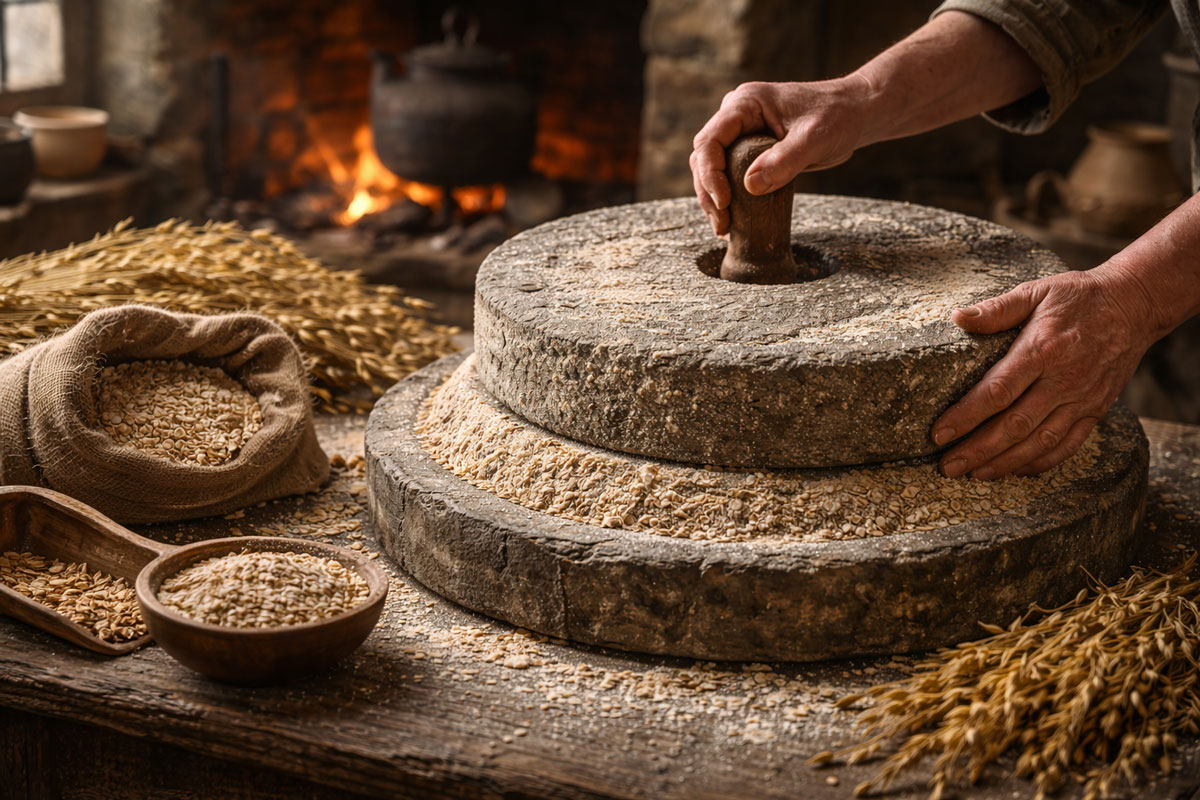
At the heart of traditional Irish oatmeal production was the quern stone. Found in archaeological sites across Ireland, querns were simple hand-operated mills consisting of two circular stones. Grain was placed between them and ground through repetitive motion, producing coarse meal.
Quern stones were often household objects, passed down through generations. Their presence in a home signified self-sufficiency. In times of scarcity or isolation, a family with a quern could still turn grain into food.
Stone grinding oats was labour-intensive. The process required patience and strength, often carried out by women and children as part of daily routines. The rhythm of grinding—steady, circular, unhurried—was as familiar as any other household task.
Unlike later watermills or industrial rollers, stone grinding did not strip away parts of the grain. The husk, bran, and germ were preserved, creating a meal rich in texture and flavour. This method respected the grain’s structure rather than forcing uniformity.
In some regions, small local mills supplemented domestic grinding. These mills still relied on stone technology, producing oatmeal that reflected the character of the grain and the land it came from.
Why Stone-Ground Oatmeal Tasted Different
Stone-ground Irish oatmeal was markedly different from the finely milled oats common today. It was coarser, heartier, and more aromatic. Because the grain was not overheated or over-processed, its natural oils remained intact, contributing to a nutty depth of flavour.
The texture varied depending on how finely the oats were ground. Some households preferred rough meal for thick porridge, while others produced a finer grind for baking or griddled breads. There was no single standard; oatmeal reflected individual taste and local custom.
This variability was not considered a flaw. It was part of the food’s character. Each batch told a story of the harvest, the stone, and the hands that worked it.
Stone grinding also affected how oatmeal behaved in cooking. Porridge made from stone-ground oats thickened slowly and evenly, developing body without becoming gluey. The result was nourishing rather than heavy, with a lingering warmth that suited Ireland’s climate.
Oatmeal in Everyday Irish Cooking
Oatmeal was far more than breakfast. It appeared in meals throughout the day, shaped by necessity and imagination. Porridge, often eaten plain or with milk, was the most common preparation, providing warmth and energy in the morning and evening.
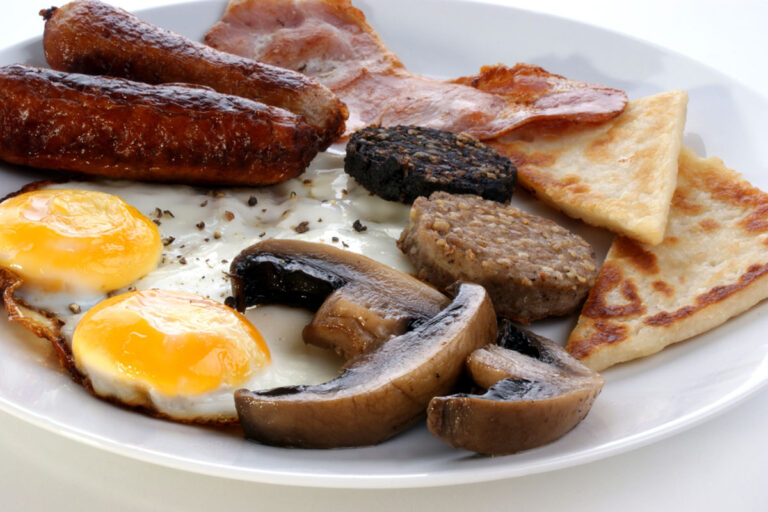
In some households, porridge was cooled, sliced, and fried the following day, creating a crisp-edged dish served with butter or buttermilk. This practice ensured no food was wasted.
Oatmeal was also used in baking. Oatcakes, griddle breads, and simple loaves relied on stone-ground oats for structure and flavour. These breads were dense, filling, and designed to sustain physical labour.
In coastal and rural areas, oatmeal was added to soups and broths, thickening them and extending scarce ingredients. It paired naturally with dairy, roots, and occasionally meat, reinforcing its role as a foundation food.
Even festive dishes sometimes incorporated oats, particularly in regions where wheat was scarce. Oatmeal’s adaptability ensured its presence at both humble and celebratory tables.
From Forgotten Practice to Modern Revival
The decline of stone grinding came with industrialisation. Roller mills produced uniform, shelf-stable oats quickly and cheaply. While this increased availability, it also flattened flavour and disconnected food from its origins.
As diets changed and convenience became central, traditional oatmeal lost prominence. It was increasingly associated with poverty or hardship, rather than nourishment and heritage.
In recent years, however, stone-ground Irish oatmeal has experienced a quiet revival. Artisan mills, heritage grain growers, and food historians are rediscovering the value of slow milling. These producers emphasise flavour, nutrition, and connection to place.
Modern cooks are also re-engaging with oatmeal’s versatility. Stone-ground oats are prized for porridge, baking, and contemporary interpretations of traditional dishes.
Stone grinding tells a broader story about Irish food culture—one of patience, resilience, and respect for raw ingredients. By returning to these methods, we recover not only taste, but a deeper understanding of how food once shaped daily life.
Irish oatmeal, ground slowly between stone, remains a reminder that nourishment is as much about process as it is about product. In its coarse grains lie centuries of labour, memory, and quiet sustenance.