


Table of Contents
- Preserving the Harvest in Ireland
- What Defines an Irish Chutney or Relish?
- The Fruits and Vegetables of Irish Preserving
- Flavour, Spices, and the Irish Table
- Tradition, Revival, and Preserving More Than Food
For centuries, Irish cooking has been shaped by the need to make the most of what the land provides. Long before refrigeration, imported spices, or year-round availability, preserving food was essential to survival. While methods such as salting, smoking, and pickling are well known, chutneys and relishes played a quieter but equally important role in Irish kitchens.
These richly flavoured preserves transformed surplus fruit and vegetables into jars of sweetness, sharpness, and spice that carried the taste of the harvest through the winter months. Today, Irish chutneys and relishes are enjoying a revival, celebrated not only for their practicality but for their deep connection to place, season, and tradition. From farmhouse kitchens to artisan producers, these preserves tell a story of resourcefulness, flavour, and the enduring rhythm of rural life in Ireland.
Preserving the Harvest in Ireland
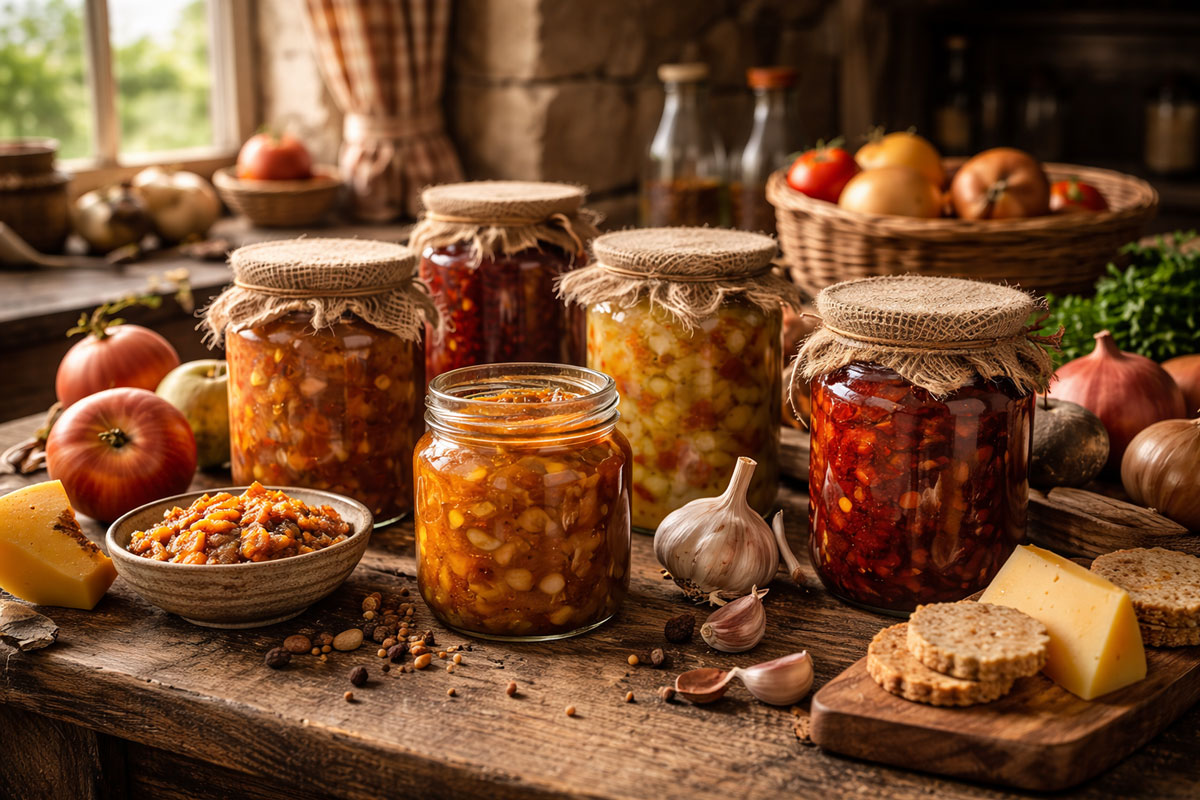
Preserving the harvest was once a matter of survival rather than choice. In rural Ireland, families relied heavily on their own gardens, small orchards, and nearby hedgerows. When vegetables ripened all at once or fruit trees produced more than could be eaten fresh, preservation ensured nothing went to waste. Jars in the pantry were not decorative; they were an extension of the field, the garden, and the hedgerow—food made reliable for the months ahead.
Vinegar, sugar, and slow cooking created an environment where food could last for months, even years. Chutneys and relishes added variety to otherwise simple diets, bringing brightness and contrast to meals built around bread, potatoes, dairy, and cured meats. In winter, when fresh greens were scarce and produce choices narrowed, a spoonful of sharp-sweet preserve could make a plate feel lively again.
Unlike jams, which leaned firmly into sweetness, chutneys and relishes occupied a more complex space. They balanced sweet and sour, soft and sharp, making them ideal companions to savoury foods. This balance became a defining feature of Irish preserves, and it also made them forgiving: a cook could adjust the flavour with what was on hand, nudging the jar toward sweeter or tangier depending on the year’s harvest.
Practical knowledge mattered. Families learned the signs of the right consistency, the patience required for slow reduction, and the importance of clean jars and tight seals. Preserving was also timed to the season—made in late summer and early autumn when apples fell, onions matured, and tomatoes finally ripened. In that way, chutney-making became part of the agricultural calendar, as routine as digging potatoes or cutting turf.
What Defines an Irish Chutney or Relish?
While chutneys have roots in South Asia, the Irish interpretation evolved into something distinct. Irish chutneys are typically thicker, gently spiced rather than fiery, and built around local produce. Apples, onions, tomatoes, and root vegetables form the backbone of many traditional recipes, with vinegar and sugar providing the structure that makes them shelf-stable and deeply flavoured.
Relishes, by contrast, are often fresher and more textured. They may be lightly cooked or even raw, designed to be eaten sooner rather than stored for long periods. In Irish cooking, relishes frequently accompanied cold meats, cheese, or fish, adding acidity and freshness to rich foods. A relish might be looser, brighter, and more “immediate,” while a chutney is usually darker, thicker, and more slowly developed.
Common characteristics of Irish chutneys and relishes include a balance of sweetness from sugar or fruit, sharpness from vinegar, slow cooking to deepen flavour, and a reliance on seasonal ingredients tied to the local harvest. The goal is not heat for its own sake, but harmony—sweetness rounded by tang, fruitiness grounded by onion, and spice used to warm the background rather than dominate the foreground.
Because Irish preserves were often made at home, recipes stayed flexible. Some families preferred a smoother chutney that sat neatly beside a slice of ham; others kept a chunkier texture that felt more rustic. Some leaned on raisins or sultanas for richness, while others preferred the clean flavour of fruit and vinegar alone. That adaptability is part of the tradition: the “right” chutney is often the one that tastes like your kitchen.
The Fruits and Vegetables of Irish Preserving
No ingredient is more closely associated with Irish chutneys than the apple. With apple trees common across the countryside, this fruit became the natural foundation for countless preserves. Windfall apples, too bruised or tart for eating, were ideal for cooking down into chutneys. They softened into the pot, contributed sweetness and body, and brought a gentle fruit character that paired beautifully with savoury foods.
Apple chutney, often combined with onions, raisins, and gentle spices, became a staple in many households. Its versatility made it invaluable, pairing equally well with cold ham, sharp cheddar, or leftover roast meat. In winter, a spoonful of apple chutney could lift a plate of plain food into something comforting and satisfying. The natural pectin in apples also helped thicken chutneys without the need for additives, reinforcing their place as a practical, economical choice.
Beyond fruit, Irish gardens provided an abundance of savoury vegetables suited to preserving. Onions, slow-cooked until soft and sweet, formed the base of many relishes. When combined with vinegar and sugar, they developed a rich, almost jam-like depth that felt both sharp and mellow. Onion relishes in particular became reliable companions to cheese, bread, and roast meats—strong enough to stand up to richness, but balanced enough to feel familiar.
Tomato relish, particularly popular in late summer, offered a way to preserve ripe tomatoes before they spoiled. Irish versions tended to be less spicy than their international counterparts, focusing instead on acidity and sweetness. These relishes were often served with fried fish, sausages, or bread and butter, and they also worked as a simple way to add brightness to sandwiches and leftover plates.
Other vegetables such as courgettes, marrow, and even beetroot found their way into chutneys when harvests were plentiful, reflecting the ingenuity of cooks who adapted recipes to whatever the land produced that year. When courgettes ran wild in August, they became relish; when beetroot was abundant, it became a darker, earthier preserve that paired well with sharp cheese. Even small-batch chutneys made from mixed odds and ends—apples, onions, a few tomatoes, and whatever else needed using—had a place in the Irish tradition of “making do well.”
Hedgerows also mattered. While not every chutney relied on foraged produce, Irish kitchens have long used what grows close by. A handful of berries, crab apples, or a late-season glut of fruit could become a small pot of preserve—something personal, seasonal, and deeply tied to place.
Flavour, Spices, and the Irish Table
Historically, spices were expensive and not always easy to obtain in Ireland. As a result, Irish chutneys developed a restrained approach to seasoning. Rather than bold heat, spices were used sparingly to add warmth and complexity. This is one reason Irish chutneys feel so adaptable: they complement rather than compete, and they sit comfortably alongside dairy and meat without overwhelming them.
Mustard seed, ginger, cloves, and occasionally cinnamon were common choices. These spices complemented the sweetness of fruit and the sharpness of vinegar without overpowering the main ingredients, creating a flavour profile that felt balanced and comforting. Even a small amount could transform a pot, turning a simple mix of apples and onions into something more rounded and memorable.
At the table, chutneys and relishes were rarely the centre of the meal but played an important supporting role. A small spoonful could transform leftovers or enhance simple foods, pairing naturally with cold meats, farmhouse cheeses, fried fish, or bread and butter. Chutney also offered contrast: it cut through fat, added sparkle to mild foods, and brought texture to plates that might otherwise feel uniform.
Common pairings included cold ham or bacon with apple or onion chutney, cheddar or farmhouse cheeses with fruit-based preserves, fried fish with tomato relish, and bread, butter, and chutney as a light meal in itself. On a modern Irish table, these preserves also shine on grazing boards—beside cured meats, pickles, pâté, and brown bread—where the sweet-sour note acts as a bridge between flavours.
In many households, jars of chutney were brought out during visits or celebrations, offering guests a taste of the home’s produce and skill. They were symbols of hospitality as much as practicality. A good chutney suggested a well-run kitchen: one that planned for winter, respected the harvest, and cared about flavour.
Even when bought rather than made, chutney often carries that same feeling. It signals something handmade, patient, and rooted—an antidote to hurried food. It also fits Irish tastes particularly well: comforting, straightforward, and quietly complex.
Tradition, Revival, and Preserving More Than Food
Preserving was often a communal activity. Recipes were shared, adapted, and passed down through generations, with each family developing its own version of a chutney based on the year’s harvest. Measurements were sometimes approximate, guided by taste, smell, and experience. What mattered was the final balance: not too sweet, not too sharp, thick enough to spoon, and lively enough to brighten a plate.
Late summer and early autumn were peak preserving seasons. Kitchens filled with the scent of simmering vinegar and fruit, jars lined up to cool, and handwritten labels marked the fruits of the year’s labour. These rituals connected families to the land and to one another, reinforcing the cyclical nature of rural life. Even today, many people recall learning to make chutneys from parents or grandparents, standing at the stove and stirring patiently as stories were shared.
In recent years, Irish chutneys and relishes have experienced a resurgence. Artisan producers and home cooks alike are rediscovering traditional methods, emphasising local sourcing, small-batch production, and seasonal cooking. Farm shops and markets now feature preserves built around Irish apples, onions, tomatoes, and heritage varieties, often designed specifically to pair with Irish cheese, smoked fish, and charcuterie.
Part of the modern appeal is sustainability. Chutney-making is one of the most satisfying ways to reduce waste: soft apples, overgrown courgettes, and surplus onions can all be turned into something valuable. It’s also a slower, more mindful kind of cooking—less about speed and more about patience, aroma, and the gradual deepening of flavour.
Irish chutneys and relishes preserve more than flavour. They preserve memory, place, and a way of life shaped by patience and care. Each jar holds a moment in the agricultural year, linking past and present through the simple act of preservation. Whether made in a farmhouse kitchen or bought from a local producer, these preserves remain small but meaningful expressions of Irish food culture—quietly sustaining, deeply rooted, and full of character.