



Long before the potato arrived in Ireland, there was barley — a humble grain that sustained the island’s people for millennia. From the earliest farmers who sowed it in stony soil to the monks who brewed ale within cloistered walls, barley has been intertwined with Ireland’s story from the beginning. It was one of the first crops ever cultivated here and remains a cornerstone of Irish life, both in the kitchen and the pint glass.
Resilient, versatile, and deeply rooted in the land, barley has fed Ireland through famine, faith, and feast. It appears in everything from soups and breads to the whiskey and beer that have carried Ireland’s name around the world. Despite centuries of change, this ancient grain still holds a vital place in Irish fields and Irish hearts.
Table of Contents
- The Grain That Built a Nation
- Ancient Origins of Barley in Ireland
- Barley in Monastic and Medieval Life
- The Brewing and Whiskey Connection
- Barley’s Revival in Modern Ireland
The Grain That Built a Nation
Barley has been part of Ireland’s landscape for more than 5,000 years. Its golden fields stretch across the country each summer, a living link to the island’s earliest farmers. Easy to grow and rich in nutrition, barley sustained generations through times of plenty and hardship alike. For centuries, it was the grain that built daily bread, fortified broths, and filled tankards with ale.
In a country known for rain and resilience, barley’s hardiness made it indispensable. It thrived where other crops struggled and formed the foundation of a food system that was as practical as it was spiritual. Whether in a bowl of warming soup, a monk’s fasting bread, or a brewer’s malted mash, barley has remained Ireland’s most enduring crop — the quiet heart of its agricultural heritage.
Ancient Origins of Barley in Ireland
Barley is among the oldest cultivated grains in human history — and in Ireland, it predates recorded civilization. Archaeological evidence shows that early farmers were growing and harvesting barley as far back as 4000 BCE, during the Neolithic period. It was one of the first crops to take root in Ireland’s cool, damp climate, thriving where wheat often failed.
Excavations at ancient sites such as Newgrange and Ceide Fields have revealed barley grains and impressions of cereal stalks preserved in the soil. These discoveries tell the story of a people who transitioned from foraging to farming, relying on hardy crops that could sustain them year-round. Barley became not just a source of food, but a foundation for settled life.
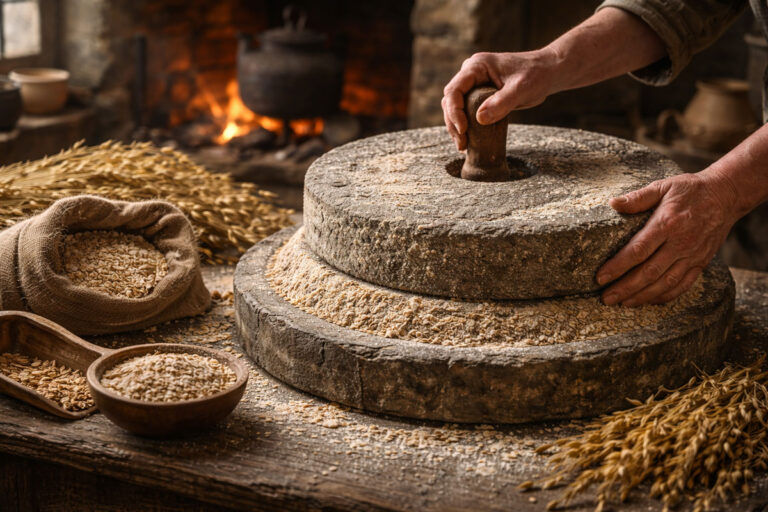
Early Irish communities used barley in multiple ways: ground into meal for bread, boiled into gruel or stirabout, and fermented into a primitive form of ale. Its versatility made it an essential part of both everyday sustenance and early ritual feasting. In fact, barley was so central that it appears in Irish mythology — linked with fertility, abundance, and the cycles of the land.
As the centuries passed, barley’s importance only deepened. It became a key trade good, a form of rent or tribute, and a symbol of prosperity. In many ways, barley was to early Ireland what the potato would later become — the grain that quietly fed the nation.
Barley in Monastic and Medieval Life
As Christianity spread across Ireland in the early centuries AD, barley became a cornerstone of monastic self-sufficiency. The monks who built Ireland’s early monasteries—places like Clonmacnoise, Glendalough, and Skellig Michael—cultivated barley in the fertile lands surrounding their communities. It was a grain of both nourishment and devotion, woven into the rhythm of daily life.
Barley bread was a staple food in these monastic settlements. While fine wheaten loaves were reserved for feast days, barley bread was the daily fare of monks and laborers alike. It was hearty, coarse, and sustaining—perfect for those living under the strict fasting rules of the monastic calendar. Combined with vegetables, herbs, and dairy, it formed the basis of a simple but balanced diet.
Barley also played a key role in monastic brewing. Many Irish monasteries maintained small breweries, producing ale that was safer to drink than water and vital during fasting periods when solid food was limited. The brewing process itself was seen as a craft of discipline and order, mirroring the monks’ devotion to prayer and labor. In this way, barley became part of both physical and spiritual sustenance.
Outside the monasteries, barley flourished in medieval Ireland as a peasant crop. It grew well in poorer soils and required less maintenance than wheat, making it ideal for small farms and tenant plots. Barley bread and porridge were everyday foods for rural families, while malted barley continued to fuel both domestic brewing and the growing trade in ale and beer.
By the end of the medieval period, barley had become inseparable from Ireland’s identity—feeding monks, farmers, and merchants alike, and linking the sacred and the ordinary in a single, golden grain.
The Brewing and Whiskey Connection
Few crops are as deeply tied to Ireland’s cultural identity as barley, and nowhere is that connection more evident than in the nation’s brewing and distilling traditions. For over a thousand years, Irish barley has provided the backbone of both ale and whiskey—two beverages that have nourished, inspired, and defined Irish life at home and abroad.
Long before commercial breweries existed, Irish monks were among the first to refine the art of brewing. Using malted barley, they crafted ales for sustenance, hospitality, and even medicinal purposes. Brewing was a daily part of monastic life, and recipes varied by region and available ingredients. These early barley-based ales were the ancestors of Ireland’s modern brewing heritage.
By the 18th century, barley had become central to another iconic craft—Irish whiskey. Distillers discovered that malted and unmalted barley together produced a distinctive, smooth spirit that became the hallmark of Irish whiskey. From small rural stills to great names like Jameson, Powers, and Bushmills, the tradition of turning barley into liquid gold spread across the island.
Barley’s dual role in both brewing and distilling helped sustain entire communities. It was not only a cash crop but a social bond, connecting farmers, maltsters, brewers, and publicans in a shared tradition. Fields of barley rippling in the wind became as much a symbol of Ireland’s economy as they were of its cultural soul.
Today, craft breweries and micro-distilleries continue to celebrate barley’s role, experimenting with heritage strains and local malting. Whether poured as a pint of stout or distilled into a glass of single malt, Irish barley remains the quiet star behind two of the country’s most beloved exports.
Barley’s Revival in Modern Ireland
Although barley has been cultivated in Ireland for thousands of years, its story is far from finished. In recent decades, there has been a quiet revival of interest in Irish barley—not just as an agricultural product, but as a symbol of heritage, sustainability, and national pride.
Modern farmers are rediscovering heritage barley varieties that were nearly lost to industrial farming. These older strains, such as Bere barley and Goldthorpe, thrive in Ireland’s damp, coastal conditions and carry richer flavors ideal for brewing, baking, and distilling. Across the country, small-scale growers and maltsters are collaborating with craft producers to restore these ancient grains to prominence.
In the brewing world, Irish craft beers increasingly highlight the provenance of their barley, emphasizing local sourcing and traditional malting methods. Distilleries, too, are turning to single-estate barley to create whiskies that express a true sense of place—showcasing the unique character of Irish soil and climate in every sip.
Outside the brewery and distillery, chefs and bakers are reintroducing barley to the table. From rustic barley soups and breads to modern salads and porridges, the grain’s versatility and nutritional value make it a natural fit for contemporary Irish cuisine. Its high fiber and low glycemic index also appeal to today’s health-conscious diners.
As conversations around food sustainability and biodiversity grow, barley stands as a model crop—resilient, adaptable, and deeply rooted in Irish life. It bridges the gap between past and present, from ancient field to modern kitchen, reminding us that the grains of history still feed the nation today.